
- 01 Quick Answer
- 02 Introduction
- 03 What Is Traditional SEO?
- 04 What Is AI SEO?
- 05 Traditional SEO vs. AI SEO: Key Differences
- 06 Why Traditional SEO Still Matters
- 07 Why AI SEO Is Becoming Important
- 08 How AI Systems Choose Content Sources
- 09 The New SEO Formula in 2026
- 10 Traditional SEO vs. AI SEO in Action
- 11 Common Mistakes Businesses Make
- 12 Best Practices for Winning in Both
- 13 The Future of SEO
- 14 Conclusion
- 15 Frequently Asked Questions (FAQs)
Quick Answer
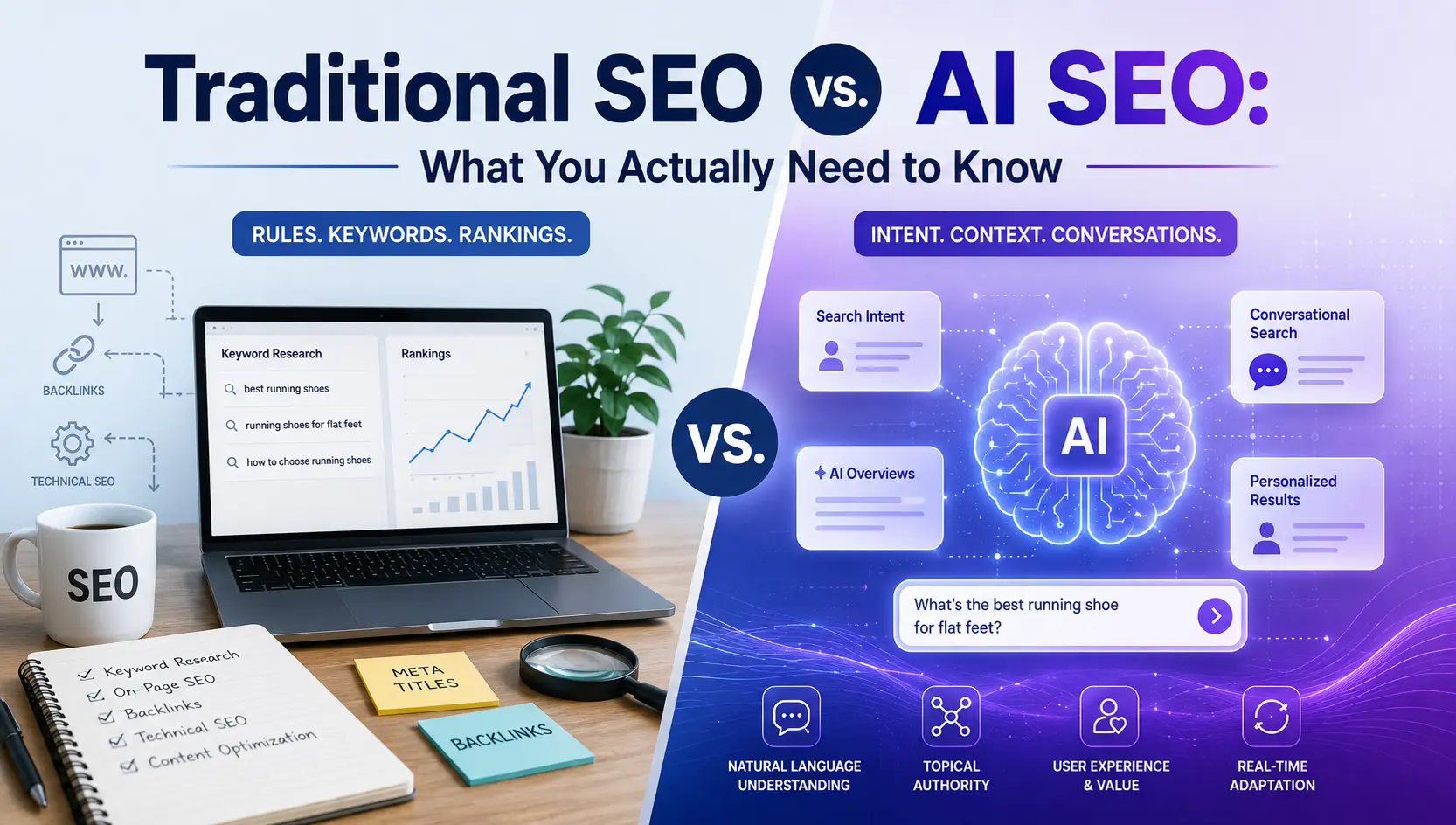
Traditional SEO focuses on improving website visibility in search engine results pages (SERPs) through keyword optimization, technical SEO, backlinks, and content quality.
AI SEO focuses on optimizing content for AI-powered search experiences, including AI Overviews, conversational search engines, generative AI platforms, voice assistants, and answer engines that provide direct responses instead of simply listing websites.
The Bottom Line
Today, businesses need both Traditional SEO and AI SEO to maximize online visibility.
Introduction
Search has changed dramatically over the past few years.
Previously, users searched on Google, clicked a website, and found their answers. Today, users increasingly get answers directly from AI-powered platforms like ChatGPT, Google's AI Overviews, Gemini, Perplexity, and other generative search engines.
This shift has created a new question for businesses:
Should you focus on Traditional SEO or AI SEO?
The answer isn't one or the other.
The brands winning today are combining both strategies to appear in traditional search results and AI-generated answers.
Let's break down the differences and understand what actually matters.
What Is Traditional SEO?
Traditional Search Engine Optimization (SEO) is the process of improving a website's visibility in search engine results.
The goal is simple:
When someone searches for a keyword related to your business, your website should appear near the top of the search results.
Traditional SEO Focus Areas
- Keyword research
- On-page SEO
- Technical SEO
- Backlink building
- Content optimization
- Internal linking
- Site speed optimization
- Mobile-friendliness
- User experience
Example
Suppose someone searches:
"Best CRM software for small businesses"
Traditional SEO aims to rank a webpage in Google's organic results for this keyword.
Users click the page, read the content, and potentially become customers.
What Is AI SEO?
AI SEO (Artificial Intelligence Search Optimization) focuses on increasing visibility within AI-generated answers.
Instead of ranking only on search result pages, the goal is to become a trusted source that AI systems reference when generating answers.
AI SEO Focus Areas
- Entity optimization
- Topical authority
- EEAT (Experience, Expertise, Authoritativeness, Trustworthiness)
- Structured data implementation
- Clear answer-focused content
- Question-based content
- Contextual relevance
- Brand mentions across the web
- Semantic search optimization
Example
A user asks ChatGPT:
"What are the best CRM tools for small businesses?"
Instead of showing ten blue links, ChatGPT may generate a direct answer mentioning several CRM platforms.
AI SEO aims to make your content influential enough to be cited, referenced, or used when generating that answer.
Traditional SEO vs. AI SEO: Key Differences
Both approaches share the same ultimate goal — visibility — but they pursue it in very different ways. Here's how they compare side by side.
| Factor | Traditional SEO | AI SEO |
|---|---|---|
| Primary Goal | Rank in search results | Appear in AI-generated answers |
| Focus | Keywords | Topics and entities |
| Success Metric | Rankings and traffic | Mentions, citations, visibility |
| User Journey | Clicks to website | Direct answers from AI |
| Optimization Style | Search engine focused | Search engine + AI model focused |
| Content Structure | Keyword optimization | Question-answer optimization |
| Authority Signals | Backlinks | Backlinks + entity authority + brand mentions |
Why Traditional SEO Still Matters
Many businesses assume AI will replace traditional search.
That's not happening anytime soon.
Google still processes billions of searches daily, and organic traffic remains one of the most valuable marketing channels.
Traditional SEO continues to deliver:
- Consistent website traffic
- Lead generation
- Brand visibility
- Sales opportunities
- Long-term ROI
Without strong SEO foundations, AI visibility becomes much harder to achieve.
Think of It This Way
Think of traditional SEO as the foundation and AI SEO as the next layer of optimization.
Why AI SEO Is Becoming Important
AI-powered search experiences are growing rapidly.
Users increasingly ask complete questions such as:
- How do I improve local SEO?
- What is the best accounting software?
- How much does SEO cost?
- Which CRM is suitable for startups?
Instead of browsing multiple websites, they often receive summarized answers instantly.
Businesses that fail to adapt may lose visibility even if they rank well in traditional search.
Benefits of AI SEO
- Visibility in AI Overviews
- Exposure in AI chat platforms
- Improved brand recognition
- Higher authority perception
- Increased citations and mentions
- Better future-proofing of content strategy
How AI Systems Choose Content Sources
AI models generally prefer content that demonstrates:
Expertise
Content created by knowledgeable professionals.
Trustworthiness
Accurate information supported by facts and evidence.
Clarity
Simple language with direct answers.
Authority
Strong brand reputation and recognition.
Topical Depth
Comprehensive coverage of a subject.
Freshness
Updated information that remains relevant.
The New SEO Formula in 2026
Successful businesses are now following this formula:
Step 1: Build Strong Traditional SEO
Focus on:
- Technical SEO
- Core Web Vitals
- Keyword targeting
- Internal linking
- Backlink acquisition
Step 2: Create AI-Friendly Content
Structure content using:
- Clear headings
- FAQ sections
- Definitions
- Examples
- Step-by-step guides
Step 3: Build Topical Authority
Instead of publishing isolated articles, create topic clusters.
Example:
If you offer SEO services, create content around:
- Technical SEO
- Local SEO
- Ecommerce SEO
- Link building
- SEO audits
- AI SEO
- Content SEO
This helps search engines and AI systems understand your expertise.
Step 4: Strengthen Brand Signals
AI models trust recognized brands.
Increase:
- Industry mentions
- Guest posts
- Digital PR
- Expert interviews
- Social proof
Example: Traditional SEO vs. AI SEO in Action
Imagine you own an SEO agency.
Traditional SEO Strategy
Target keywords such as:
- SEO services
- Local SEO agency
- SEO consultant
- Technical SEO expert
Goal:
Rank on Google's first page.
AI SEO Strategy
Create detailed content answering:
- What does an SEO consultant do?
- How much does SEO cost?
- Is SEO worth it in 2026?
- Traditional SEO vs AI SEO
Goal:
Become a trusted source referenced by AI systems.
The Takeaway
The most successful agencies do both.
Common Mistakes Businesses Make
Only Focusing on Keywords
Modern search engines understand topics and intent, not just keywords.
Ignoring AI Search Trends
AI-generated answers are becoming a major discovery channel.
Publishing Thin Content
Surface-level articles rarely earn trust from users or AI systems.
Neglecting Brand Authority
Strong brands are cited more frequently by both journalists and AI systems.
Forgetting User Intent
Search visibility means little if content doesn't solve real problems.
Best Practices for Winning in Both Traditional SEO and AI SEO
- Answer questions directly.
- Use clear heading structures.
- Include examples and case studies.
- Add FAQ sections.
- Build topical authority.
- Keep content updated.
- Improve technical SEO.
- Earn quality backlinks.
- Use schema markup.
- Demonstrate expertise and trustworthiness.
The Future of SEO
SEO is not dying.
It's evolving.
The future belongs to businesses that understand that search visibility now exists across multiple platforms:
- Google Search
- AI Overviews
- ChatGPT
- Gemini
- Perplexity
- Voice search assistants
Instead of optimizing for a single search engine, marketers must optimize for how information is discovered everywhere.
Conclusion
Traditional SEO and AI SEO are not competitors.
They work together.
Traditional SEO helps your website rank in search engines and attract traffic. AI SEO helps your brand become visible in AI-generated answers and emerging search experiences.
Businesses that combine both approaches will have a significant advantage as search continues to evolve.
The smartest strategy is simple:
Smartest Strategy
Build a strong SEO foundation, create authoritative content, and optimize for both humans and AI systems.
Frequently Asked Questions (FAQs)
Is AI SEO replacing traditional SEO?
No. AI SEO complements traditional SEO rather than replacing it. Both are important for online visibility.
What is the difference between SEO and AI SEO?
SEO focuses on ranking webpages in search engines, while AI SEO focuses on becoming a trusted source for AI-generated answers and search experiences.
Can AI-generated content rank on Google?
Yes, provided it is helpful, accurate, original, and adds value to users. Quality matters more than the content creation method.
How do I optimize content for AI Overviews?
Create comprehensive content, answer questions directly, use structured headings, demonstrate expertise, and build topical authority.
Does AI SEO require technical SEO?
Yes. Technical SEO remains important because search engines and AI systems rely on well-structured websites for understanding content.
Which is more important in 2026: Traditional SEO or AI SEO?
Neither should be ignored. The best strategy is integrating both Traditional SEO and AI SEO into a single search visibility strategy.