- 01 Quick Answer
- 02 The Search Landscape Is Changing
- 03 What Is SEO?
- 04 What Is GEO?
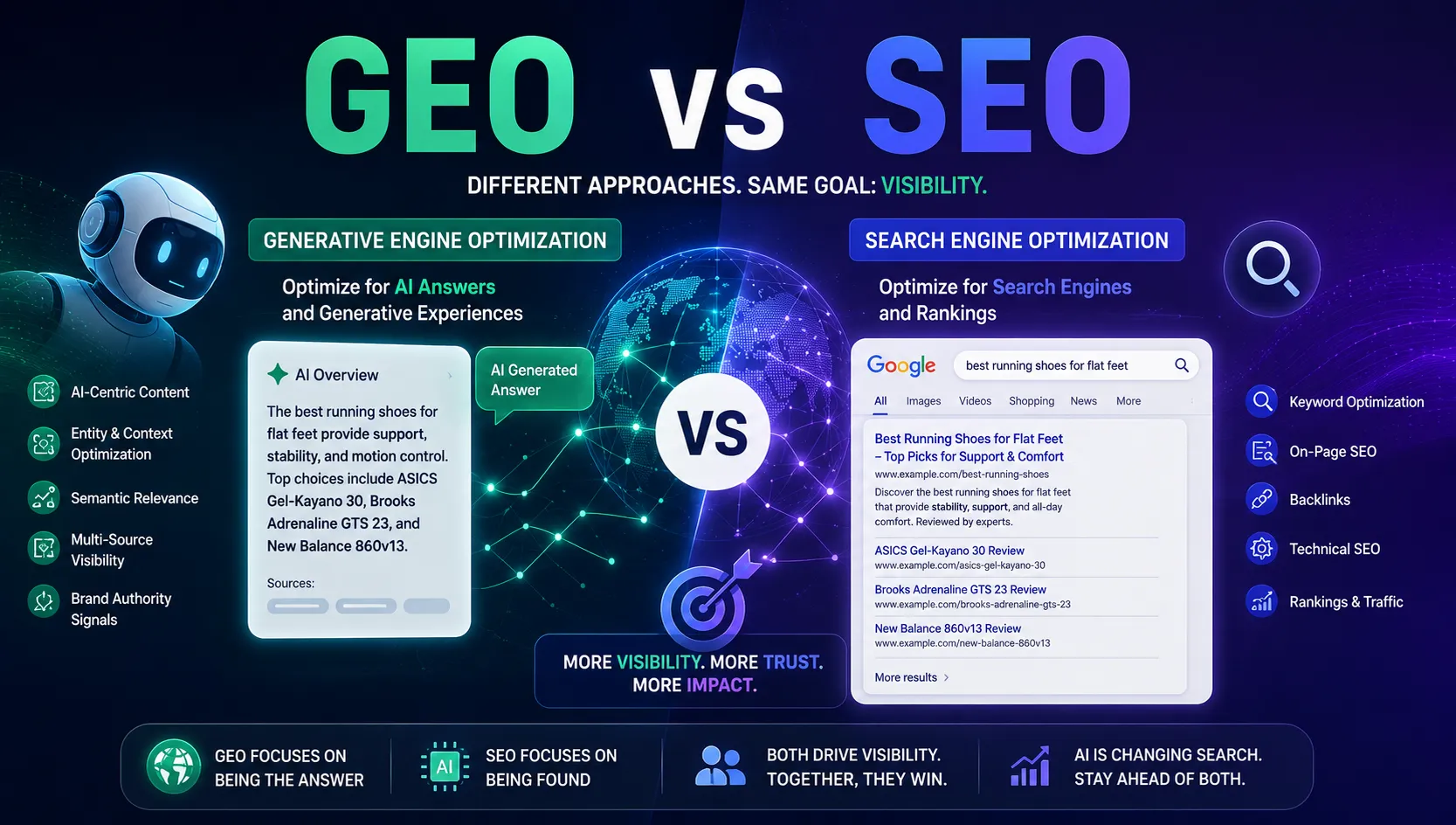
- 05 GEO vs SEO: Key Differences
- 06 Why GEO Is Gaining Attention
- 07 Why SEO Still Matters
- 08 How AI Systems Choose Sources
- 09 SEO Strengths
- 10 GEO Strengths
- 11 Example: SEO vs GEO for a Marketing Agency
- 12 Should Businesses Prioritize GEO or SEO?
- 13 The Winning Strategy for 2026
- 14 The Future of Search
- 15 Final Thoughts
- 16 Frequently Asked Questions
Quick Answer
Businesses should not choose between GEO and SEO—they should invest in both.
SEO (Search Engine Optimization) helps your website rank in traditional search engine results like Google and Bing. GEO (Generative Engine Optimization) helps your content get cited, referenced, and recommended in AI-powered search platforms such as ChatGPT, Google AI Overviews, Gemini, Perplexity, and Microsoft Copilot.
In 2026, SEO drives organic traffic, while GEO increases visibility in AI-generated answers. The most successful businesses combine both strategies to maximize their online presence.
Key Takeaway
SEO and GEO are complementary, not competing. SEO builds your website's authority and traffic. GEO ensures AI systems recognize and recommend your brand in generated answers.
The Search Landscape Is Changing
For more than two decades, SEO was the primary way businesses gained visibility online.
The process was straightforward:
- Users searched on Google.
- Google displayed search results.
- Users clicked a website.
- Businesses generated traffic, leads, and sales.
Today, things are different.
Users increasingly ask questions directly to AI-powered platforms:
- What is the best CRM software?
- Which SEO agency should I hire?
- What are the top project management tools?
- How much does website development cost?
Instead of showing a list of links, AI systems often generate complete answers.
This shift has introduced a new discipline called GEO.
What Is SEO?
SEO (Search Engine Optimization) is the practice of improving a website's visibility in traditional search engine results.
The goal is to rank higher when users search for relevant keywords.
Example
If someone searches:
“Best digital marketing agency in London”
SEO helps your website appear on Google's first page for that query.
Key SEO Activities
- Keyword research
- On-page SEO
- Technical SEO
- Link building
- Content optimization
- Internal linking
- Site speed optimization
- Local SEO
Primary Goal of SEO
Generate website traffic from search engines.
What Is GEO?
GEO (Generative Engine Optimization) is the process of optimizing content so AI-powered search engines and assistants can understand, trust, and reference it in their responses.
Rather than focusing solely on rankings, GEO focuses on becoming a trusted source of information.
Example
A user asks ChatGPT:
“What are the best SEO agencies for startups?”
Instead of showing ten blue links, the AI generates a direct answer.
GEO aims to position your brand, content, and expertise so AI systems include you in those recommendations.
Key GEO Activities
- Creating authoritative content
- Building topical authority
- Strengthening brand signals
- Optimizing entities
- Publishing expert insights
- Structuring content clearly
- Demonstrating expertise and trust
Primary Goal of GEO
Increase visibility in AI-generated answers and recommendations.
GEO vs SEO: Key Differences
| Factor | SEO | GEO |
|---|---|---|
| Focus | Search engine rankings | AI-generated answers |
| Goal | Website traffic | AI visibility |
| Optimization Target | Search engines | AI systems and search engines |
| Success Metric | Rankings and clicks | Mentions, citations, recommendations |
| Content Approach | Keyword-focused | Topic-focused |
| User Journey | Clicks website | Gets answer from AI |
| Importance of Brand | Moderate | Very High |
Why GEO Is Gaining Attention
The growth of AI-powered search has changed how users discover information.
Many people now use:
- ChatGPT
- Google AI Overviews
- Gemini
- Perplexity
- Microsoft Copilot
Instead of browsing multiple websites, users receive summarized answers instantly.
As AI adoption grows, businesses want to ensure they remain visible within these experiences.
This is where GEO becomes important.
Why SEO Still Matters
Some marketers claim SEO is dead.
The data says otherwise.
Traditional search engines continue to process billions of searches every day.
Users still click websites when they:
- Compare products
- Research services
- Read reviews
- Make purchasing decisions
SEO remains one of the most cost-effective long-term marketing channels.
Without strong SEO foundations, GEO becomes much harder to achieve.
Think of SEO as the Foundation
SEO is the foundation and GEO is the next evolution. You cannot build effective GEO on a weak SEO base.
How AI Systems Choose Sources
One of the biggest misconceptions is that AI simply selects content from top-ranking websites.
In reality, AI systems evaluate multiple signals.
Expertise
Does the content demonstrate real knowledge?
Authority
Is the website recognized within its industry?
Trustworthiness
Can the information be trusted?
Brand Recognition
Is the business mentioned across the web?
Content Quality
Does the content provide helpful and accurate answers?
Topical Authority
Does the website cover the topic comprehensively?
These signals influence whether AI systems choose to reference your content.
SEO Strengths
SEO is ideal when your goal is:
Driving Website Traffic
Organic search remains a major traffic source.
Generating Leads
Users actively searching often have high buying intent.
Increasing Brand Awareness
Ranking for important keywords improves visibility.
Building Long-Term Assets
Quality content can generate traffic for years.
GEO Strengths
GEO is ideal when your goal is:
Increasing AI Visibility
Appear in AI-generated recommendations.
Building Authority
Become a trusted source within your industry.
Future-Proofing Marketing
Prepare for the continued growth of AI-powered search.
Expanding Brand Reach
Gain exposure beyond traditional search engines.
Example: SEO vs GEO for a Marketing Agency
Imagine a digital marketing agency.
SEO Strategy
Target keywords such as:
- SEO services
- Local SEO agency
- Technical SEO consultant
Goal: Rank higher in Google.
GEO Strategy
Create content around:
- How much does SEO cost?
- Is SEO worth it in 2026?
- What is AI SEO?
- SEO mistakes businesses make
Goal: Become a trusted source that AI systems cite when answering related questions.
The Strongest Approach
The strongest agencies use both strategies together—targeting traditional search rankings while building authority that AI systems recognize and recommend.
Should Businesses Prioritize GEO or SEO?
The answer depends on your current situation.
If You're Just Starting
Prioritize SEO first.
Build:
- Technical SEO foundation
- Keyword-targeted content
- Internal linking
- Backlinks
- Website authority
Without these fundamentals, GEO efforts may struggle.
If You Already Have Strong SEO
Expand into GEO.
Focus on:
- Expert-led content
- Topical authority
- Brand building
- AI-friendly content structures
- Comprehensive topic coverage
If You Want Maximum Visibility
Invest in both.
This is the approach most future-focused businesses are adopting.
The Winning Strategy for 2026
Instead of choosing between SEO and GEO, combine them.
- Build strong SEO foundations.
- Create comprehensive content clusters.
- Answer real customer questions.
- Strengthen EEAT signals.
- Build a recognizable brand.
- Monitor both search and AI visibility.
The businesses that dominate search in 2026 will be visible wherever users seek answers.
The Future of Search
Search is becoming more conversational.
Users are increasingly asking questions rather than typing keywords.
As a result:
- SEO is evolving.
- AI search is growing.
- Brand authority matters more.
- Helpful content wins.
The future belongs to businesses that can educate, inform, and build trust across both traditional search engines and AI-powered platforms.
Final Thoughts
GEO and SEO are not competing strategies.
They solve different visibility challenges.
SEO helps people find your website through search engines.
GEO helps AI systems understand, trust, and recommend your content.
Businesses that focus only on SEO may miss opportunities in AI-powered search.
Businesses that focus only on GEO may miss valuable organic traffic.
The smartest approach is to build a strong SEO foundation while gradually incorporating GEO best practices.
That combination will provide the greatest visibility, authority, and growth opportunities in the years ahead.
Frequently Asked Questions
What is GEO in digital marketing?
GEO stands for Generative Engine Optimization. It focuses on optimizing content so AI-powered search engines and assistants can reference and recommend it in generated answers.
What is the difference between GEO and SEO?
SEO focuses on ranking webpages in search engines, while GEO focuses on increasing visibility within AI-generated responses and recommendations.
Is GEO replacing SEO?
No. GEO complements SEO rather than replacing it. Both strategies work together to improve online visibility.
Which is more important in 2026: GEO or SEO?
Neither should be ignored. SEO remains essential for traffic generation, while GEO is becoming increasingly important for AI visibility.
Can small businesses benefit from GEO?
Yes. AI systems often prioritize expertise and relevance, allowing smaller businesses to compete with larger brands.
How do I optimize my website for GEO?
Focus on topical authority, expert content, brand building, structured content, FAQs, and demonstrating trustworthiness.
Does GEO require backlinks?
Backlinks remain valuable, but GEO also relies heavily on expertise, authority, content quality, and brand recognition.
Should local businesses invest in GEO?
Absolutely. As consumers increasingly use AI platforms to find services and recommendations, GEO can help local businesses gain additional visibility.